

Updated on April 1, 2026
How to Punch Harder Using Physics (Not Just Muscles) Part 2
📚 Previously in Part 1...
We learned the science of the kinetic chain: how force travels from the ground through the 5-link pathway, and the common power leaks where energy escapes when stabilizing muscles fail to engage.
Now it's time to apply that knowledge with actual training methods used at Bamboo Kung Fu.
← Revisit Part 1: The Science of PowerIn Part 2: Training Methods & Conditioning
Traditional Weapons Conditioning
Punching Bag Conditioning
Specialized Bean-Filled Bag Training
Choy Li Fut Foreknuckle Strike
Finger Stab Conditioning
Progressive Filler Materials
The Art of Timing (On-Off Wave)
The Four-Stage Progression
Health & Safety Prerequisites
Ancient Conditioning: How Traditional Weapons Forge the Kinetic Chain
↩ back to table of contents
Here's a powerful truth often overlooked: the traditional weapons of Chinese martial arts are not just for fighting. They are brilliantly designed conditioning tools that directly build the specific strength and stability your kinetic chain needs for empty-hand power.
The 8-Foot Long Pole: Forging Shoulder Girdle & Wrist Integrity
Wielding a heavy, 8-foot long pole is one of the most demanding exercises for your upper body kinetic chain.
Why it works:
The long lever arm of the pole dramatically increases the rotational force (torque) your muscles must control. Simply holding it level requires immense, continuous tension from your scapular stabilizers, rotator cuff, and core.
The Conditioning Effect:
Practicing techniques like sweeping, thrusting, and circling forces your shoulder girdle to learn true dynamic stability—the ability to remain solid and retracted while in motion. This directly translates to maintaining that crucial "stable platform" during a punch. Furthermore, controlling the pole's momentum builds tremendous wrist and forearm strength, preventing that "deadly bent wrist" collapse on impact.
The Jian (Straight Sword): Precision for Grip, Wrist, & Forearm
While the pole builds raw stability, the light, double-edged Jian (straight sword) trains surgical precision and fine motor control.
Gripping Strength:
The Jian is not held loosely. It requires a live, responsive grip—often described as "holding a bird without crushing it or letting it fly away." This develops exceptional forearm and finger strength without the bulkiness of weightlifting, leading to a firmer, more connected fist.
Wrist Mobility & Precision:
Techniques rely on precise flicks, turns, and stops of the wrist (called wan). This conditions the wrist for both the mobility needed to snap the fist into alignment and the stability to lock it upon impact. It teaches your wrist to be both fluid and iron-strong in an instant.
The Takeaway: Incorporating traditional weapons practice isn't just cultural preservation; it's applied biomechanical conditioning. The pole builds the structural integrity of Links 4 & 5 (shoulder to wrist), while the sword refines the neurological control of your grip and wrist. Together, they forge the very chain your power travels through.
Punching Bag Conditioning: Feeling the Kinetic Chain
↩ back to table of contents
While shadowboxing and slow-motion practice build the neurological patterns, punching bag work is where you truly learn to "feel" the kinetic chain in action. The heavy bag provides essential feedback that air punching cannot.
The Bag as Your Teacher
A properly executed punch on a heavy bag should create a "wave effect" through the entire bag, not just a surface impact. This visual feedback tells you whether you're channelling full-body power or just "arm punching."
Sensory Feedback Loop
When you strike correctly, you'll feel a distinct energy transmission sensation starting from your driving foot, travelling up your leg, through your rotating hips and spine, and finally exploding through your fist.
Heavy Bag vs Light Bag: Different Tools for Different Power Development
Understanding the difference between heavy bag and light bag training is crucial for developing complete striking power. Each teaches different aspects of the kinetic chain:
Heavy Bag
(70-100+ lbs)
Primary Purpose: Power Generation & Structure
Kinetic Chain Focus: The initial drive phase - ground force generation through hip rotation.
Light Bag
(25-30 lbs)
Primary Purpose: Penetration & Speed
Kinetic Chain Focus: The final acceleration phase - thoracic whip through fist snap.
Specialized Training: The Bean-Filled Punching Bag
↩ back to table of contents
At Bamboo Kung Fu, we've developed specialized training tools that go beyond commercial equipment. Our homemade bean-filled punching bags offer unique training benefits that standard bags cannot replicate.
Unlike uniformly filled commercial bags, our bean-filled bags create a unique physical phenomenon we call "reactive resistance."
-
Individual Bean Dynamics
Each bean acts as an independent mass. When your fist strikes, the beans directly under impact compress while the surrounding beans shift away, then return. This creates a reactive "push back" sensation similar to striking muscle tissue. -
Variable Density Zones
Beans naturally settle into different density patterns. Striking different areas teaches you to adapt force application - just as you would against different body parts (ribs vs abdomen vs muscle). -
Training Benefit - "Hits Back"
This unique feedback serves as instant error correction. Poor technique, like arm punching, results in sharp, stinging feedback, while proper kinetic chain engagement creates a deep, resonant "thump." The bag literally teaches proper form through physical feedback.
Choy Li Fut Specialization: The Foreknuckle Strike
↩ back to table of contents
While most striking arts impact with the flat of the knuckles, Choy Li Fut kung fu includes specialized techniques like the foreknuckle strike (similar to the panther fist). This requires unique kinetic chain adaptations and specialized conditioning.
The Physics of Foreknuckle Striking
Foreknuckle techniques operate on different physical principles than standard punching:
Pressure vs Force
Pressure = Force ÷ Area
By reducing the impact area to a single knuckle, the same kinetic chain force creates dramatically higher pressure, allowing penetration through denser targets.
Structural Alignment
The kinetic chain must channel energy through a single, perfectly aligned knuckle rather than distributing it across several. This requires perfect wrist and forearm alignment.
The Stability Paradox of Foreknuckle Striking
Given the lower inherent stability of the small finger joints, the effectiveness of the foreknuckle technique is offset by the dramatically higher pressure it generates. However, this does not mean that less effort or focus is required for stabilizing these smaller joints.
In fact, the stability of the smaller finger joints is entirely dependent upon a stable foundation from the preceding joint—in this case, the comparatively larger and stronger wrist joint. The fingers cannot compensate for a collapsing wrist; they can only transmit what the wrist delivers.
The kinetic chain principle applies here with absolute precision: Bigger joints must do their job first. The wrist must be locked and aligned before the foreknuckle can even hope to channel force. The shoulder must stabilize the wrist, the spine must rotate to drive the shoulder, the hips must power the spine, and the legs must ground the hips. Only when the entire chain is engaged—from the ground up through the comparatively massive joints of the leg, hip, spine, and shoulder—can the small finger joints safely and effectively deliver the concentrated pressure of the foreknuckle strike.
This is why foreknuckle training is never approached in isolation. It is the culmination of the complete kinetic chain, not a shortcut around it.
Bamboo Kung Fu's Dynamic Conditioning Method: Finger Stab Training
↩ back to table of contents
To develop the specialized finger stability required for pressure point strikes, we use a unique dynamic conditioning method that trains the entire kinetic chain—from the ground through the interphalangeal joints.
Bean Bag Catching & Clawing for Finger Stab Conditioning
Our bean bag catching and clawing method focuses on catching and clawing a floating bean bag before it drops to the floor. The practitioner must track the bag's trajectory, position the body, and execute a clawing catch with the fingertips—often at the last possible moment.
-
Interphalangeal Joint Integrity
The fingers contain two sets of small joints: the proximal interphalangeal (PIP) joints—the middle knuckles—and the distal interphalangeal (DIP) joints—the last knuckles before your fingertips. These must remain stable upon impact with the bean bag. -
Kinetic Chain Continuation
The floating bag catch forces the practitioner to maintain the entire chain—stable wrist, locked scapula, rotated thoracic spine, engaged core, driven hips, and grounded feet. -
Eccentric Loading
Catching a falling object requires the fingers to decelerate momentum while simultaneously gripping—precisely what happens during a finger stab technique.
(Distal Interphalangeal)
The last knuckle
before your fingertip
(Proximal Interphalangeal)
The middle knuckle
of your finger
Your finger has three bones and two joints. The PIP joint is the first bend after your knuckle; the DIP joint is the last bend before your fingernail.
Progressive Filler Material: From Beans to Pebbles
↩ back to table of contents
The conditioning effect of the bean bag is not just in the catching motion—it is also in the filler material itself. We progressively increase the density and abrasiveness of the bag's contents to safely condition the fingertip tissue and bone density.
Stage 1: Pure Bean Filling
Light beans (mung, adzuki)
- Softest impact, develops basic claw formation
- Trains finger positioning without discomfort
- Builds confidence in joint stability
Stage 2: Bean & Small Pebble Mix
70% beans, 30% small pebbles
- Variable density provides unpredictable feedback
- Pebbles create micro-point pressure on fingertips
- Begins conditioning fingertip tissue
Stage 3: Pebble-Dominant Mix
50% beans, 50% small pebbles
- Higher abrasive resistance conditions fingertip skin
- Promotes bone density adaptation
- Simulates impact against harder targets
⚠️ Important Safety Note: Progression through filler stages must be gradual. Pain in the joints (PIP or DIP) indicates technique failure or too-rapid progression. Pain in the fingertip pads is normal adaptation; pain in the joints is a warning sign.
The Art of Timing: The "On-Off" Wave
↩ back to table of contents
There's another layer of sophistication that separates novice practitioners from true martial artists: the duration and timing of muscle engagement.
The "On-Off" Wave
Muscle activation travels through your body as a wave, each segment engaging for only 20-40 milliseconds before releasing to let the wave pass to the next link.
Timeline of muscle engagement during a 150ms punch
The Common Mistake
Beginners engage muscles too early and hold tension too long. This slows the punch and masks the feeling of true kinetic chain transfer.
The Master's Approach
Elite practitioners engage each muscle group for only milliseconds—turning on and off at precisely the correct moment in the sequence.
⏱️ The 10,000-Hour Reality
Developing this timing requires thousands of focused repetitions across all training modalities. Each rep, each form, each round of sparring adds another layer to the neurological foundation. Be patient—your nervous system is literally rewiring itself with every practice session.
The Four-Stage Progression
↩ back to table of contents
Stage 1: Forms
Build neural patterns in a distraction-free environment. Thousands of repetitions to encode the on-off wave.
Stage 2: Bag Drills
Add tactile feedback. Learn to feel and hear the difference between correct and incorrect timing.
Stage 3: Partner Drills
Introduce unpredictability. The on-off wave must now adapt to variable timing and distance.
Stage 4: Sparring
Make it instinctive under pressure. The on-off wave becomes automatic, even against a resisting opponent.
The paradox of power: Maximum force comes not from maximum tension, but from perfectly timed, brief engagements that allow energy to flow freely through the chain without interference. The art of movement is knowing when to turn on—and just as importantly, when to turn off.
Important: Health Prerequisites for Practice
The kinetic chain principles described in this series are powerful tools—but they require a healthy physical foundation to apply safely.
Building the Foundation: Flexibility & Mobility
Developing the range of motion required for proper kinetic chain engagement is essential. Tight hips, a stiff thoracic spine, or restricted ankle mobility will limit your ability to execute the 5-link pathway correctly.
Our kung fu classes at Bamboo Kung Fu systematically develop this flexibility through traditional conditioning methods, progressive stretching, and targeted exercises.
⚠️ When NOT to Train: Injury Contraindications
It is not recommended to participate in striking practice if you have:
All injuries must be resolved or appropriately managed before resuming striking practice. Attempting to train through injury creates compensatory patterns that become ingrained technique errors and can turn acute issues into chronic problems.
The Responsible Path Forward
Consult with a healthcare professional for proper diagnosis. Complete prescribed rehabilitation. Gradually reintroduce movement under supervision. At Bamboo Kung Fu, our instructors work with students returning from injury—provided they have medical clearance and communicate their limitations clearly.
The Final Word: Power is a Skill
Powerful striking isn't a genetic gift or a result of brute strength alone. It's a trainable skill based on applied physics and biomechanics.
By understanding your body as a kinetic chain and learning to channel force from the ground up—using specialized tools like traditional weapons, reactive bean bags, and dynamic drills—you stop pushing with your arm and start launching with your entire body.
Now, go train that chain.
Ready to Apply These Principles?
Book a free trial class to work on your kinetic chain with expert guidance at Bamboo Kung Fu.
You may be interested in:
Kung Fu performance at the 2023 Toronto Chinatown Festival
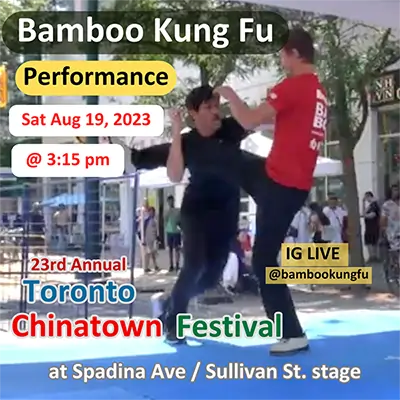
Bamboo Kung Fu students will perform Chinese martial arts on stage at the 23rd Toronto Chinatown Festival on Saturday, August 23, 2023. Our show will begin at 3:15 pm (UTC/GMT -4).
The martial arts show will be held at Spadina Avenue and Sullivan Street.
More - Martial art performance at the 2023 Toronto Chinatown Festival
Stances - The Most Important Secret in Martial Arts Practice
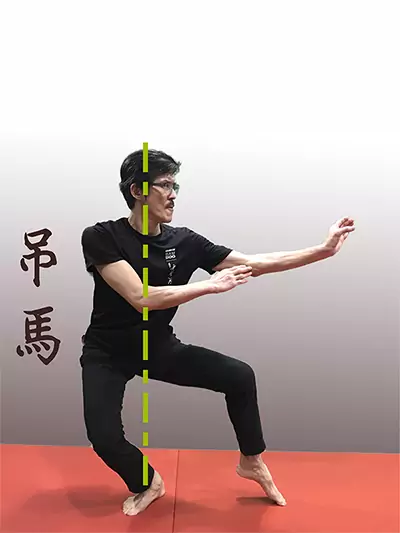
Stance is the ultimate foundation in martial arts practice. Stance is the essence of any kung fu practice. Without it, the quality and leverage of the kung fu techniques will not be effective.
More - Stances: the most important foundation in martial arts practice
Punching Power “Leaks”: How Bad Posture Lowers Punching Power
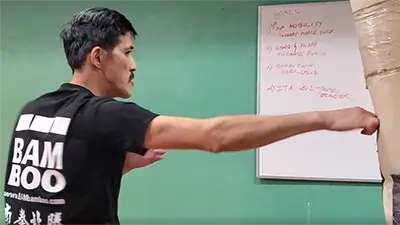
Does bad posture reduce punching power in kung fu? Yes. Forward-rounded shoulder posture reduces the leverage of the kinetic chain and affects punch accuracy, especially in Buk Sing Choy Li Fut kung fu.
More - How Bad Posture Causes Punching Power Leaks
Kung Fu Online Live Martial Arts Classes Long Distance Learning
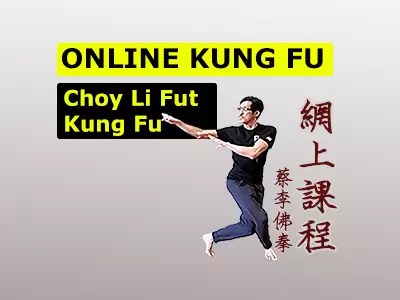
Online live interactive martial arts classes in the comfort of your home. Go to kung fu classes without travelling
More - Online Kung Fu classes
LIVE Online Kung Fu-Blind River, Elliot Lake, Thessalon, Bruce Mines
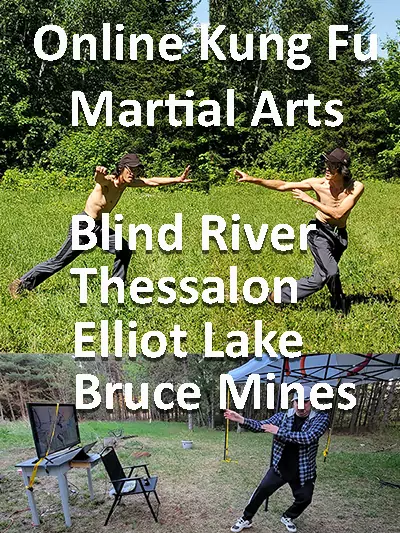
LIVE Online Kung Fu in the townships of Blind River, Elliot Lake, Thessalon, and Bruce Mines in northern Ontario.
Our online classes are cast LIVE from our location in downtown Toronto. Our online classes are Hybrid classes. This means the online classes are run together with in-person classes.
More - Online Kung Fu-Blind River, Thessalon, Elliot Lake, Bruce Mines in northern Ontario
Adult kung fu
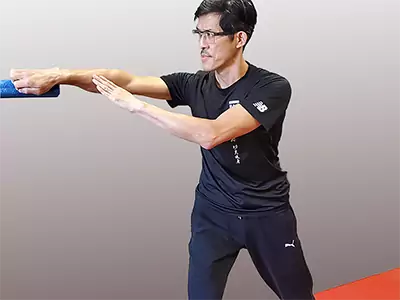
In-person and online options available.
Choy Li Fut kung fu is a dynamic martial art style with a diverse repertoire of movements. Class curriculum:
Primary goal: Improve overall fitness.
Secondary goal: Gain self-defence knowledge, Foster good biomechanics and posture to help you in day-to-day activities of daily living (ADL).
Everyone is welcome, with or without previous martial arts training experience.
More about Adult kung fu
Children kung fu
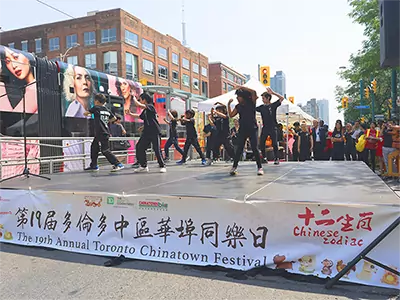
In-person and online options available.
Studies have shown the positive trends of long-term participation in physical activity programs such as martial art. Such programs help improve children’s executive functions i.e., creativity, flexibility, self-regulation, discipline, and working memory functions.
By instilling good movement patterns in the children’s kung fu program, children will gain the foundation which will set them up for a healthy and active lifestyle.
More about Children's kung fu
Essentrics™-stretching, strengthening, mobility full body exercise
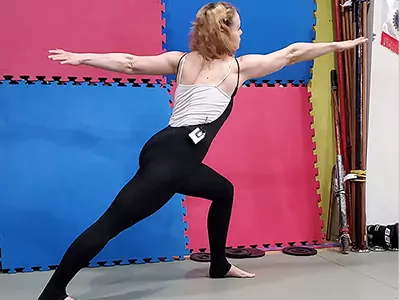
In-person and online options available.
Essentrics™ is a full-body workout that draws inspiration from ballet, Tai-Chi, that develops lean, strong muscles and improves your posture. The fluid and dynamic movements nature of the exercise is low impact and improves joint health. Lighten up your mood and move to the rhythm of the songs playlist.
More about Essentrics™