

Updated on March 30, 2026
How to Punch Harder Using Physics (Not Just Muscles) Part 1
The content is in editing stage
Have you ever wondered why some smaller martial artists can hit with devastating power, while bigger, more muscular practitioners struggle to generate real force in their strikes? The secret isn't in the size of their muscles—it's in their understanding of human biomechanics and physics.

In this article, we'll break down exactly how power travels from the ground through your body to your fist, following the same principles used in Choy Li Fut kung fu, boxing, and other striking arts. Whether you're throwing a straight punch or a hook like Mike Tyson, the science remains the same.
In Part 1: The Science of Power
Where Does Punching Power REALLY Come From?
Your Body as a Kinetic Chain
The 5-Link Power Pathway
Traditional Weapons Conditioning
Common Power Leaks: Lumbar & Arm
👉 Continue to Part 2 for Training Methods & Conditioning
Where Does Punching Power REALLY Come From? (Hint: Not Your Arms)
↩ back to table of contents
Contrary to what you might think, your biceps and shoulders are not the main source of power. In fact, relying on them alone is the most common mistake we see.
Think of it this way: Your arm is merely the delivery system—the final link in a powerful chain that starts much lower in your body. The real engines are your legs, hips, and core. This is why a perfectly executed punch feels like your whole body is launching forward, not just your fist.
True power comes from learning to channel force from the ground up, a concept we'll explore in detail.
Your Body Isn't a Pole—It's a Kinetic Chain
↩ back to table of contents
If your body were one solid, rigid pole, transferring force would be easy. Push one end, and the other end moves instantly.
But we're not poles. We're a series of linked segments—a kinetic chain. Your bones are the links, and your joints (ankles, knees, hips, spine, shoulders) are the connections.
The Chain Problem:
Imagine pushing a chain laid out on a table. It just bunches up and collapses. Power gets lost at every loose, wobbly link.
The Chain Solution:
Now imagine if you could momentarily tighten and lock every link in that chain. Suddenly, you could push force through it effectively. This is what happens in a great punch.
To punch with power, you must learn to stabilize each joint at the exact moment force passes through it. This turns your flexible body into a temporary, solid structure for power transmission.
The 5-Link Power Pathway: From Your Feet to Your Fist
↩ back to table of contents
Let's trace the exact journey of force, link by link, during a powerful straight punch or cross.

-
Link 1: The Pre-Loaded Spring-Off (Foot & Ankle)
Power generation starts in your stance. A good fighting stance isn't static; it's a coiled spring. The bent knee position stores elastic energy in your quadriceps and glutes. The punch initiates with a sudden explosive spring-off—driving the ball of your foot down and into the ground. This action leverages the ankle's natural second-class lever to maximize the ground's reactive push-back. -
Link 2: The Engine Block (Hip Rotation & Pelvic Stability)
The force from your leg drives your rear hip forward and around. But this is not merely a rotation—it is a transfer of energy through a precisely engineered anatomical structure.Anatomical Insight: The pelvis and sacrum region function as a stable pedestal for the successive links in the kinetic chain—particularly the lumbar spine above it. The orientation of the hip bones is such that they push into the centre of the pelvic bucket, concentrating all the energy generated from the legs into a single point.
This focal point is biomechanically significant: it is the approximate location of the dantien (丹田)—the body's energetic centre in traditional Chinese martial arts—and it coincides with the body's centre of gravity. From a physics standpoint, this is the optimal location for force convergence before energy travels upward through the spine.
The pelvis does not simply rotate; it gathers and focuses the ground force from both legs, channelling it through this central hub. This concentrated energy then transfers to the lumbar spine, which—as we've established—must remain stable to transmit power upward effectively.
⚡ The Dantien Connection: Ancient Wisdom Meets Modern Biomechanics
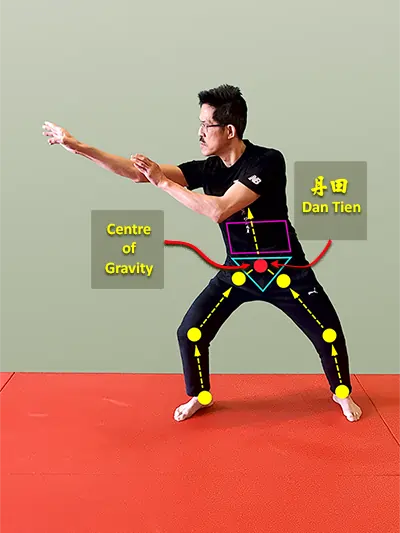
Diagram showing the modern biomechanics force lines from the ground up from the ankle through legs, pelvis (dantien), to the lumbar spine, and further upwards, corresponding to the Chinese ancient wisdom of the Dan Tien 丹田 .
The dantien (丹田) has been described in Chinese martial arts for centuries as the body's centre of energy. Modern biomechanics confirms this: it corresponds precisely to the body's centre of gravity, located in the lower abdomen approximately 2-3 inches below the navel.
In the kinetic chain, the pelvis and sacrum act as a convergence point—a stable pedestal that collects ground force from both legs and funnels it through this central hub. The orientation of the hip bones directs energy inward toward this single point, creating a concentrated reservoir of power before it travels up the spine.
This is why traditional training emphasizes "sinking the qi" to the dantien—it's a physical instruction to ground force through the pelvis, not just an energetic metaphor.
Think of the pelvis as a funnel: wide at the bottom to collect force from the legs, narrowing to a single point (the dantien/centre of gravity) where all energy concentrates before being distributed upward through the stabilized spine. -
Link 3: The Power Amplifier & Stability Hub (Thoracic Rotation & Lumbar Stability)
Here's a secret many miss: the power from your hips is amplified by your mid-back (thoracic spine). This is the biomechanical key behind the powerful rotations in Choy Li Fut and Mike Tyson's hooks. However, thoracic rotation can only generate power if the lumbar spine (lower back) remains stable. The lumbar spine doesn't rotate much—only about 1 to 2 degrees—because its main job is stability. Think of the lumbar spine as the solid anchor point that allows the thoracic spine to twist like a coiled spring. Without lumbar stability, rotational energy dissipates through a swaying lower back, robbing your punch of power and exposing your spine to injury. Engage your deep core muscles to lock the lumbar spine in neutral alignment, creating a rigid transmission hub between the rotating hips and the twisting thoracic spine. -
Link 4: The Stable Platform (Scapula & Shoulder)
For force to cleanly enter your arm, you need a stable base. This is achieved by scapular retraction and depression—pulling the shoulder blade back and down onto your rib cage. -
Link 5: The Final Delivery (Arm, Fist & Wrist)
Finally, the force enters your arm. Most critically, your wrist must be perfectly straight and locked. A bent wrist absorbs the energy meant for your target.

Critical Biomechanical Insight: The lumbar spine is the stability hub of the kinetic chain. It does not rotate—it stabilizes. Think of it as the solid foundation that allows the thoracic spine to act as a whip and the hips to act as an engine. It's a launching pad! An unstable lumbar spine is the #1 hidden power leak in rotational striking.
Ancient Conditioning: How Traditional Weapons Forge the Kinetic Chain
↩ back to table of contents
Here's a powerful truth often overlooked: the traditional weapons of Chinese martial arts are not just for fighting. They are brilliantly designed conditioning tools that directly build the specific strength and stability your kinetic chain needs for empty-hand power.
The 8-Foot Long Pole: Forging Shoulder Girdle & Wrist Integrity
Wielding a heavy, 8-foot long pole is one of the most demanding exercises for your upper body kinetic chain.
Why it works:
The long lever arm of the pole dramatically increases the rotational force (torque) your muscles must control. Simply holding it level requires immense, continuous tension from your scapular stabilizers, rotator cuff, and core.
The Conditioning Effect:
Practicing techniques like sweeping, thrusting, and circling forces your shoulder girdle to learn true dynamic stability—the ability to remain solid and retracted while in motion. This directly translates to maintaining that crucial "stable platform" during a punch. Furthermore, controlling the pole's momentum builds tremendous wrist and forearm strength, preventing that "deadly bent wrist" collapse on impact.
The Jian (Straight Sword): Precision for Grip, Wrist, & Forearm
While the pole builds raw stability, the light, double-edged Jian (straight sword) trains surgical precision and fine motor control.
Gripping Strength:
The Jian is not held loosely. It requires a live, responsive grip—often described as "holding a bird without crushing it or letting it fly away." This develops exceptional forearm and finger strength without the bulkiness of weightlifting, leading to a firmer, more connected fist.
Wrist Mobility & Precision:
Techniques rely on precise flicks, turns, and stops of the wrist (called wan). This conditions the wrist for both the mobility needed to snap the fist into alignment and the stability to lock it upon impact. It teaches your wrist to be both fluid and iron-strong in an instant.
The Takeaway: Incorporating traditional weapons practice isn't just cultural preservation; it's applied biomechanical conditioning. The pole builds the structural integrity of Links 4 & 5 (shoulder to wrist), while the sword refines the neurological control of your grip and wrist. Together, they forge the very chain your power travels through.
Common Power Leaks: Where Most Martial Artists Lose Force (Part 1)
↩ back to table of contents
Knowing the pathway is half the battle. The other half is plugging the leaks where energy escapes. The kinetic chain is only as strong as its weakest link—and for many martial artists, these common errors undermine everything.
Arm Punching
The Error: Throwing from the shoulder without leg or hip drive.
Why It Fails: You're using only arm muscles—the weakest part of the kinetic chain. Power never gets started.
The Fix: Initiate every punch with a ground push. Feel the spring-off before your arm moves.
Lumbar Instability #1 Hidden Leak
The Error: Lower back sways, arches, or rotates during the punch.
Why It Fails: Severs the connection between hip drive and thoracic rotation. Energy dissipates before reaching your shoulders.
The Fix: Brace your core. Lumbar STABILIZES while thoracic ROTATES. Practice the dowel rod drill.
Continue to Part 2: Training Methods & Conditioning
Now that you understand the science, learn how to apply it:
Part 2 covers heavy/light bag protocols, progressive filler materials, and complete training cycles
You may be interested in:
Kung Fu performance at the 2023 Toronto Chinatown Festival
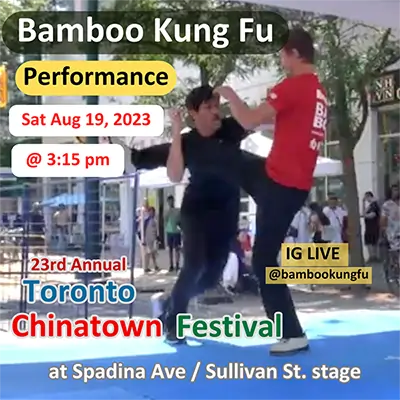
Bamboo Kung Fu students will perform Chinese martial arts on stage at the 23rd Toronto Chinatown Festival on Saturday, August 23, 2023. Our show will begin at 3:15 pm (UTC/GMT -4).
The martial arts show will be held at Spadina Avenue and Sullivan Street.
More - Martial art performance at the 2023 Toronto Chinatown Festival
Stances - The Most Important Secret in Martial Arts Practice
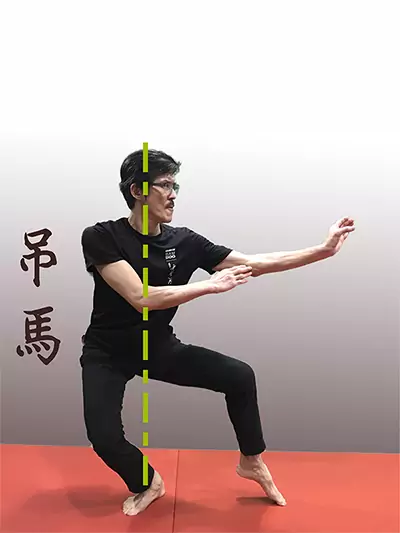
Stance is the ultimate foundation in martial arts practice. Stance is the essence of any kung fu practice. Without it, the quality and leverage of the kung fu techniques will not be effective.
More - Stances: the most important foundation in martial arts practice
Punching Power “Leaks”: How Bad Posture Lowers Punching Power
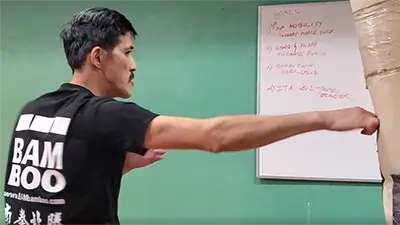
Does bad posture reduce punching power in kung fu? Yes. Forward-rounded shoulder posture reduces the leverage of the kinetic chain and affects punch accuracy, especially in Buk Sing Choy Li Fut kung fu.
More - How Bad Posture Causes Punching Power Leaks
Kung Fu Online Live Martial Arts Classes Long Distance Learning
Online live interactive martial arts classes in the comfort of your home. Go to kung fu classes without travelling
More - Online Kung Fu classes
LIVE Online Kung Fu-Blind River, Elliot Lake, Thessalon, Bruce Mines
LIVE Online Kung Fu in the townships of Blind River, Elliot Lake, Thessalon, and Bruce Mines in northern Ontario.
Our online classes are cast LIVE from our location in downtown Toronto. Our online classes are Hybrid classes. This means the online classes are run together with in-person classes.
More - Online Kung Fu-Blind River, Thessalon, Elliot Lake, Bruce Mines in northern Ontario
Adult kung fu
In-person and online options available.
Choy Li Fut kung fu is a dynamic martial art style with a diverse repertoire of movements. Class curriculum:
Primary goal: Improve overall fitness.
Secondary goal: Gain self-defence knowledge, Foster good biomechanics and posture to help you in day-to-day activities of daily living (ADL).
Everyone is welcome, with or without previous martial arts training experience.
More about Adult kung fu
Children kung fu

In-person and online options available.
Studies have shown the positive trends of long-term participation in physical activity programs such as martial art. Such programs help improve children’s executive functions i.e., creativity, flexibility, self-regulation, discipline, and working memory functions.
By instilling good movement patterns in the children’s kung fu program, children will gain the foundation which will set them up for a healthy and active lifestyle.
More about Children's kung fu
Essentrics™-stretching, strengthening, mobility full body exercise
In-person and online options available.
Essentrics™ is a full-body workout that draws inspiration from ballet, Tai-Chi, that develops lean, strong muscles and improves your posture. The fluid and dynamic movements nature of the exercise is low impact and improves joint health. Lighten up your mood and move to the rhythm of the songs playlist.
More about Essentrics™